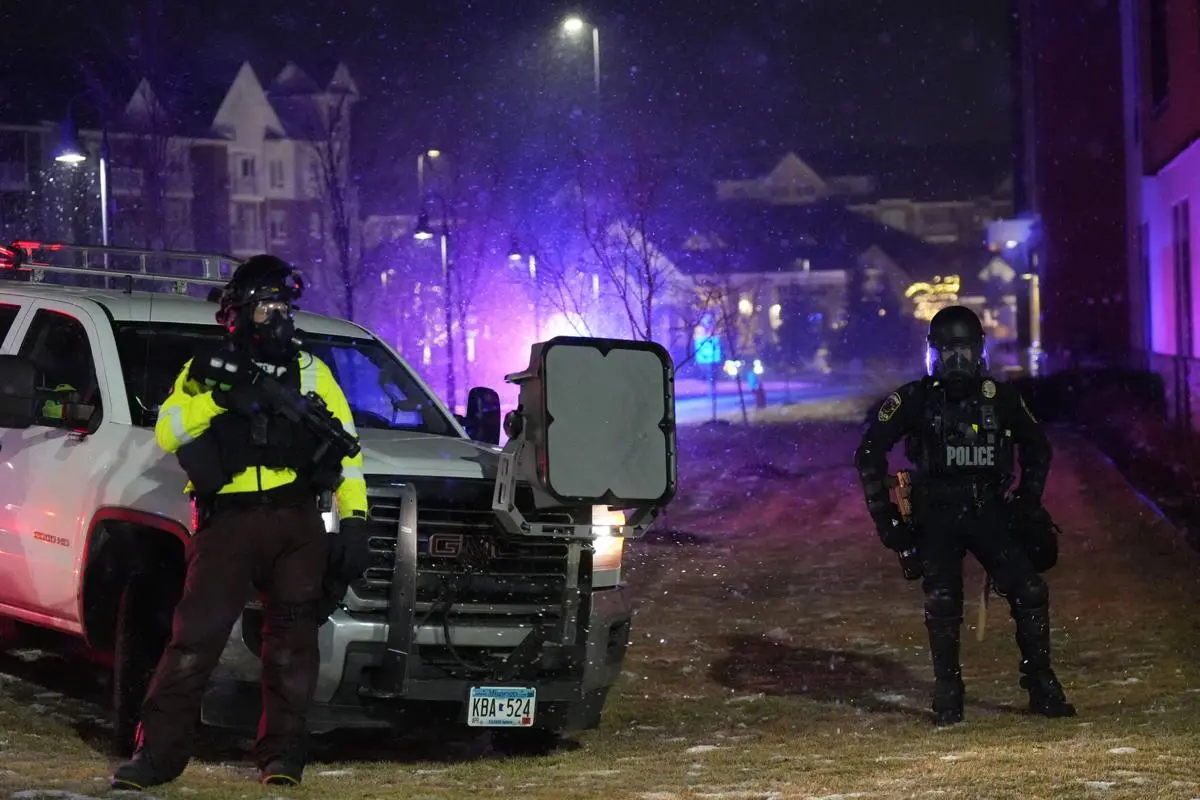
The Minnesota State Patrol confirmed that troopers used a long-range acoustic device during a protest in Maple Grove, Minnesota, on January 26, 2026. The demonstration took place outside a hotel where protesters believed a senior U.S. Border Patrol official was staying. The incident resulted in multiple arrests and brought renewed public attention to the use of specialized sound-based communication equipment by law enforcement.
According to authorities, demonstrators gathered during the evening hours and remained outside the hotel for an extended period. Law enforcement officials said the group created sustained noise and did not comply with repeated requests to disperse. As the situation continued, troopers deployed the acoustic device to ensure that instructions could be heard clearly by the entire crowd.
Following the dispersal effort, the Minnesota State Patrol reported that 26 individuals were arrested. Charges included unlawful assembly and misdemeanor riot, both of which are used under Minnesota law when groups refuse to disperse after being ordered to do so by law enforcement.
Law Enforcement Explanation of Events
State Patrol officials said that officers attempted standard crowd-control measures before using the long-range acoustic device. These measures included verbal commands and the use of traditional amplification methods. When those efforts proved ineffective due to crowd noise and distance, troopers turned to the LRAD as a communication tool.
Officials emphasized that the device was operated in “voice mode” only. They stated that no high-pitched alert tones or siren-like sounds were used during the protest, addressing claims that circulated online suggesting protesters were exposed to painful sound bursts.
The State Patrol said volume levels were monitored throughout the deployment and that troopers followed established procedures designed to prevent harm. According to officials, the purpose of the device was not to deter protesters through discomfort, but to broadcast dispersal orders clearly and uniformly.
The agency noted that it has owned an LRAD since 2013 and that its use is limited to specific situations involving large crowds where standard communication methods are insufficient.
What Is a Long-Range Acoustic Device?
A long-range acoustic device, commonly referred to as an LRAD, is a high-powered sound projection system designed to transmit sound over long distances with focused directionality. The technology was originally developed for military and maritime use, including ship-to-ship communication and perimeter security.
Unlike conventional loudspeakers, an LRAD emits sound in a narrow beam. This allows spoken messages to travel farther with greater clarity while reducing sound dispersion outside the targeted area. As a result, individuals standing directly in front of the device hear the sound much more clearly than those positioned to the sides.
In civilian law enforcement settings, LRADs are typically mounted on vehicles or portable stands and are used to issue announcements such as dispersal orders, emergency instructions, or public safety messages during large outdoor gatherings.
Some LRAD models are capable of producing high-volume alert tones intended to gain attention quickly. Law enforcement agencies state that these tones are used sparingly and that many deployments rely exclusively on voice amplification.
Because LRADs can produce very loud sound levels at close range, agencies establish operational guidelines regarding distance, volume, and duration of use. Training generally emphasizes controlled deployment to minimize risk while achieving effective communication.
Public Demonstration in Maple Grove
The Maple Grove protest was connected to broader opposition to federal immigration enforcement activity occurring in Minnesota at the time. Demonstrators gathered near the hotel to express objections to immigration policy and to the presence of federal officials in the state.
Authorities said the protest extended late into the evening and generated complaints related to noise and disruption. Law enforcement officials stated that their priority was maintaining public safety while balancing the right to protest.
As the protest continued without dispersal, troopers determined that additional measures were necessary to communicate with the crowd effectively. The LRAD was used to issue clear instructions directing demonstrators to leave the area.
Officials reported that no injuries were associated with the deployment of the device. They said arrests occurred only after demonstrators failed to comply with dispersal orders.
Arrests and Legal Framework
Those arrested during the Maple Grove protest were charged under Minnesota statutes related to unlawful assembly and riotous conduct. Under state law, an unlawful assembly occurs when individuals gather in a manner that presents a risk to public safety and refuse to disperse when ordered by law enforcement.
Misdemeanor riot charges can be applied when a group acts in a disorderly manner that threatens public peace. Law enforcement officials said the charges were based on behavior observed during the protest and failure to comply with lawful orders.
Authorities have not publicly disclosed the names of all individuals arrested or the outcomes of their cases. Legal proceedings related to the arrests were ongoing at the time of reporting.
Use of LRADs in Public Safety
LRADs have been used by law enforcement agencies across the United States in various public safety situations, including protests, emergency evacuations, and large public gatherings. Supporters of the technology argue that it allows officers to communicate clearly without resorting to physical force.
Critics have raised concerns about the potential effects of loud sound exposure, particularly if devices are used improperly or at close range. Civil liberties organizations have called for clear policies, transparency, and public reporting when such equipment is deployed.
In response to these concerns, many agencies have implemented training requirements and internal guidelines governing when and how LRADs may be used.
State Patrol Policy and Oversight
The Minnesota State Patrol said that use of specialized equipment such as LRADs is governed by internal policies and subject to review. Officials stated that the agency evaluates each deployment to ensure compliance with training and operational standards.
The patrol emphasized that LRADs are considered a communication tool rather than a weapon and that their use is intended to reduce the need for more forceful crowd-control methods.
Officials said the agency continues to review its crowd management practices as public demonstrations evolve and grow in size and complexity.
Conclusion
The January 26, 2026, protest in Maple Grove and the use of a long-range acoustic device by the Minnesota State Patrol highlighted the challenges law enforcement faces when managing large demonstrations. Authorities described the deployment as a measured effort to communicate dispersal orders clearly and maintain public safety.
While officials stated that the device was used within established guidelines and without causing injury, the incident has contributed to broader discussions about protest management, transparency, and the tools available to law enforcement.
As demonstrations related to immigration policy and other national issues continue, the Maple Grove incident serves as an example of how emerging technologies intersect with public assembly, law enforcement responsibilities, and ongoing public debate.
This article has been spell-checked and reviewed for punctuation by artificial intelligence.